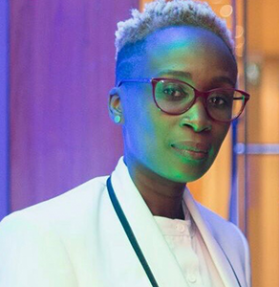
Yvonne Odour - Kenya
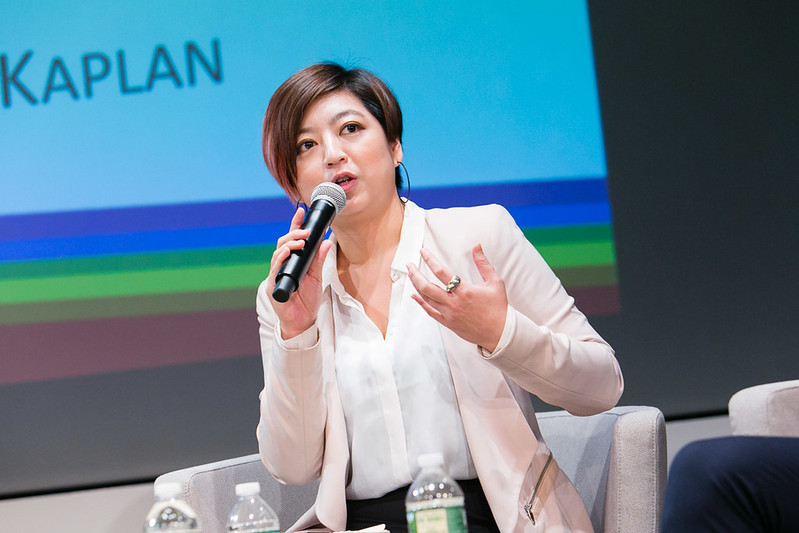
Jennifer Lu - Taiwan
Tonight in our second half, we’ll hear some recordings Naomi made at the OutSummit. on LGBTQI human rights in December at CUNY Law School. We’ll hear part of the panel titled LGBTQI movement Successes and Failures. Including OutSummit reports from Jennifer Lu from Taiwan, Fadi Saleh from Syria, and Yvonne Odour a Kenyan from North Africa.
But first, we’ll be exploring an issue of vital importance to the future of WBAI and the five-station Pacifica Radio Network that will be soon decided by you listener members and staff members of Pacifica network. We are bringing this discussion to the air because the very existence of WBAI and thus Out-FM and all of the station’s shows are at stake. Guests: Stahimili Mapp and Mimi Rosenberg, both members of WBAI Fightback.
Track 1 – Together by Betty
JR: Welcome to Out-FM, the weekly progressive lesbian, gay, bisexual, transgender, queer, questioning, intersex and two-spirit program on listener sponsored WBAI/NY, part of the Pacifica Network dedicated to peace and justice. That song you heard was “Together” by Betty. I’m John Riley, cohosting tonight with Bob Lederer. Naomi Brussel is recovering from an illness tonight, and is listening. Tonight in our second half, we’ll hear some recordings Naomi made at the OutSummit. on LGBTQI human rights in December at CUNY Law School. We’ll hear part of the panel titled LGBTQI movement Successes and Failures. including reports from Taiwan, Syria, and North Africa.
BL: But first, we’ll be exploring an issue of vital importance to the future of WBAI and the five-station Pacifica Radio Network that will be soon decided by you listener members and staff members of Pacifica network. We are bringing this discussion to the air because the very existence of WBAI and thus Out-FM and all of the station’s shows are at stake. We’ll be taking listener-calls later on.
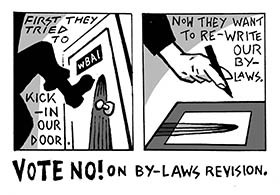
JR: As many of you know, WBAI was shut down for a month in October in a plot orchestrated by Pacifica’s former national executive director and a handful of rogue members of the Pacifica National Board. After firing the entire staff and locking out all the producers, they piped in programming and music from the California and Texas stations. On October 7, the same day the Executive Director accompanied by National Board member from Houston Bill Crosier marched in with guards to accomplish this, in Berkeley another part of their faction was filing a lawsuit in California state court to force the network to hold a referendum on completely rewritten by-laws that they had crafted in secret.
BL: The proposed bylaws, misleadingly styled as mere “amendments,” are a 180-degree reversal of the democratic gains won in 2002 following a large-scale 3-year mass protest movement throughout Pacifica, capped by a yearlong uprising here at WBAI after what became known as the the Christmas coup, the firing of managers and staff in 2000. In 2002, because of the movement’s pressure, the 4 lawsuits filed by listeners, staff, and local board members were settled with an agreement that overturned the neoliberal board and required new bylaws providing for elected local and national boards to replace the previous system of self-appointed boards. This new governance system guaranteed a strong degree of local involvement by the local communities that each of the 5 stations serve. Local station boards were set up, and those local boards select the national board. The local boards are elected by listener members as well as paid and unpaid staff, all using ranked choice elections. The local boards power are responsible for evaluations of the station’s general manager and Program director, as well as recommendations about their future. Those boards are also tasked with recommending the annual budget. The Pacifica National Board has 3 listener rep and 1 staff rep elected by each local station board, plus two representatives of affiliate stations who carry Pacifica programs.
JR: But under the proposed new by-laws, all power would be invested at the top of Pacifica in a manner similar to the clique that carried out what many have called the coup at WBAI in October 2019.
JR: All of the democratic advances would be wiped away except for a charade of democracy. The local station boards would be abolished, the current Pacifica National Board – including all those just elected weeks ago from the 5 stations -- would be replaced. For at least the first six months, the entire board would be composed of six people not involved with Pacifica who were secretly selected by the clique seeking to take over. Later, token elections would be held for one representative from each station, but they would be outnumbered by the appointed board members and thus lack any real power. The voices of listener members would by severely muted and all staff formally excluded from participation in governance.
BL: For WBAI in particular, the new structure greatly increases the grave danger that the station itself would have its broadcast license sold to shore up the finances of the remaining stations, a solution that some of those behind these new bylaws have advocated.
BL: The clique behind the anti-democratic bylaws collected a mere 600 petition signatures out of Pacifica’s 45,000-plus members nationwide and then got a California judge, who just happens to be a former Berkeley Pacifica station programmer, to force Pacifica’s boards to vote on their bylaws and then quickly submit it to a very expensive referendum of the national membership. Already, 3 of the local boards – including the one here at WBAI -- have rejected the new bylaws and 2 more have yet to vote. But the final say is in the hands of the listener and staff members nationally. Around February 17, ballots asking for a yes-or-no vote will be distributed to all Pacifica station members in both email and regular-mail form. Listeners are considered members if they donated $25 or more during calendar year 2019.
JR: Here to talk about all this are two guests, Stahimili Mapp, a Black lesbian activist, Out-FM segment producer, and WBAI listener activist, and Mimi Rosenberg, longtime legal-aid attorney, labor, community and anti-racist activist, and co-producer of WBAI’s Building Bridges: Your Community and Labor Report (Mondays, 7 pm) as well as Equal Rights and Justice (Thursdays at 9 am). They are both active with the new WBAI Fightback group, a united front of staff and listeners from the various opinion groups at the station, which formed in the wake of the October coup. This conversation will be joined by Out-FM cohost Bob Lederer and myself, John Riley, and both of us are Fightback members as well.
BL: Thanks for joining us, Stahimili and Mimi, and welcome to Out-FM. I want to start with some quick background about your involvement in fighting the October coup and how that set the stage for the current battle over the bylaws. We’ll start with Stahimili Mapp: Can you talk about what propelled you into action with WBAI Fightback?
JR: Mimi, tell us in a nutshell why you believe these proposed new bylaws would be so antithetical to the nature of WBAI and Pacifica as community-control media – and why members should care about something often considered obscure like bylaws?
BL: Stahimili, why do you and the other members of WBAI Fightback feel so strongly that these restructured bylaws would be so harmful to WBAI and Pacifica?
JR: Soon we’ll open the lines for listener calls on this topic. Please grab a pencil and piece of paper and write 212-209-2877. Bob, tell us more about what the new board would look like after the referendum for at least the first 6 months,
[Replacing it would be a 6 person appointed board selected by the drafters of the proposed by-laws who would have total power over the network. Eventually there would be local elections but only for one Pacifica Board representative instead of four. There would no longer be ranked choice voting only winner take all elections the staff would be disqualified from being on the national board.]
BL: Mimi Rosenberg, why would these completely rewritten bylaws put the very existence of WBAI at stake?
JR: Let’s open the lines for listener calls on this topic. 212-209-2877. 212-209-2877. [You’re on the air. Please tell us your first name and your comment or question.]
BL: We are at the end of this segment. Can you briefly summarize why you believe it is so important for listeners and staff to vote no on these rewritten by-laws?
Thanks listeners for your calls. Now it’s time to move on to our next segments:
1551 (12 min)
While Taiwan has now legalized a form of same-sex marriage, it is not equal to the law of marriage for heterosexual people. Limitations include lack of adoption rights, except for step children. The homosexual sex has never been illegal in the republic of China, but it has been a long struggle to create LGBT marriage law. In 2003 a bill was introduced into the executive Yuan, but faced strong oppositon. In 2004 discrimination on the basis of sexual orientation and gender identity and gender characteristics in education has been banned nationwide since 2004. Employment discrimination has been banned since 2007. Attitudes about homosexuality have changed in Taiwan massively since I lived there in 1985. Then homosexuality was stigmatized, marriage essentially compulsory. Gay men were often married to women and their homoseuuality was accepted unless it interferred with their family life. Opinions have changed in the last 35 years.LGBT pride cellibrations occur in several cities on the island of Taiwan attended by tens of thousands of people including crowdes of upto 137,000 people in 2018. In 2015 one poll showed 75% supporting gay marriage.
Jennifer Lu has been devoting in LGBT rights movements for 15 years in Taiwan and she currently is Chief Coordinator of Marriage Equality Coalition Taiwan and also long-term workers in Taiwan Tongzhi (LGBTQ+) Hotline Association. She is an activist, feminist, writer, political worker, and also passionate about encouraging more young LBT leaders to join the movement. She led the team successfully to achieve a lot of milestones in Taiwan in recent years and will continue fighting for equality in the future. Next an excerpt from her presentation about successes and failures of the LGBT movement at the OutSummit which was hosted by OutRight international.
Track 3
That was Jennifer Lu discussing the success and failures of the Taiwanese LGBT movement regarding LGBT marriage.
Fadi Saleh is a scholar-activist from Syria. His main research areas are queer and trans migration, LGBTIQ refugee politics, and knowledge production around gender and sexuality in the Middle East and North Africa, with a special focus on Syria. In addition to research, Fadi works with many LGBTIQ organizations in the MENA region and Europe in different consultancy, training, and advocacy capacities.
Next we’ll hear Fadi Saleh discussing lessons learned by the LGBTQI movements he’s been involved with. He’ll address how to mainstream the movement’s agenda.
Track 4
That was Fadi Saleh of Syria describing many success stories in the North Africa and Middle East. Next he describes the use of social media in organizing in North Africa and the Middle East.