Out-FM is a weekly progressive queer show on listener-sponsored, noncommercial WBAI/Pacifica Radio. It airs at 99.5 and wbai.org, generally on Tuesdays from 8-9 PM. Please support us by donating to WBAI. Become a member for $25 or a BAI Buddy (sustainer) for $5/month or more. Or give to our Tower Fund https://wbai.wedid.it/campaigns/10022-tower-fund/. Or go to wbai.org or call 212-209-2950 and let WBAI management know you listen to Out-FM by supporting the station with a donation. Be sure and mention us when you donate.
Sign up for Out-FM's Weekly Newsletter with show announcements.
Tune into Out-FM on Tues., Feb. 8, 2022 from 8:00-9:00pm, on 99.5FM WBAI/NY & listen at https://www.wbai.org/listen-live/
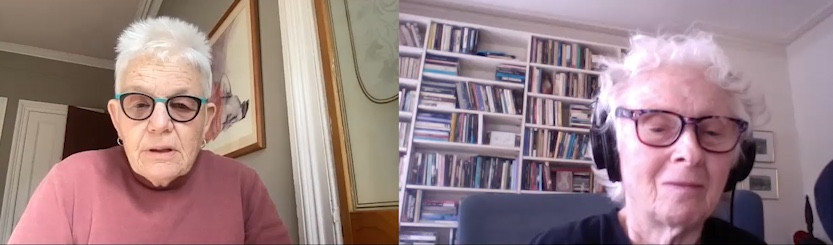
Julie Schwartzberg (L) & Naomi Brussel (R)
Eric Adams Supports Medicare (Dis)Advantage for NYC Retirees
Out-FM co-host Naomi Brussel interviews Julie Schwartzberg about the latest in the fight against Medicare (Dis) Advantage to preserve quality healthcare for NY City retirees. Julie retired from the New York city department of health in 2002 where she worked as a field worker and trainer in the HIV epidemiology program. She was a union activist and organizer during the years that she was a municipal worker. She served as vice president of local 768, DC-37 of the American Federation of state county and municipal employees, which represented health department and health and hospitals workers in New York city. She was also a founder and co-chair of the District Council 37 lesbian and gay issues committee and an organization that convinced the union to lobby for and help with domestic partner benefits in New York city. She has been a leading organizer with the Cross Union Retirees Organizing Committee against this New York city government plan.
Schwartzberg discusses the battle against the changes in retiree benefits in which Medicare covers the retirees for 80% of the cost of the healthcare and the city pays the balance. Under the Medicare (Dis)Advantage program, which is administered by a for-profit company, they city would no longer be paying 20% that it currently pays. The price is many procedures require pre-authorization approval, which is what keeps down costs for the city, but may mean retirees don’t get the healthcare they need. Schwartzberg also discusses the demonstration planned for Valentines Day to pressure the mayor. Gather on 2/14/2022 at 12pm on Broadway at Murray St.
She also urges people to Contact Mayor Adams via phone by calling 311 and leaving a message for the mayor and/or the internet
https://www1.nyc.gov/office-of-the-mayor/contact-the-mayor.page
For more information write This email address is being protected from spambots. You need JavaScript enabled to view it.
Or go to nycretirees.org
facebook page of NYC Organization of Public Service Retirees. https://www.facebook.com/groups/888622578669131
The educational webinar "Medicare Privatization: How It Really Works" will take place Tues., Feb. 15 at 7:30 PM. It is sponsored by Physicians for a National Health Program - NY Metro Chapter. To register, and for more details, go to https://www.pnhpnymetro.org/
Rally against Adams' privatization of Medicare on Mon., Feb. 14 at noon. Local map:
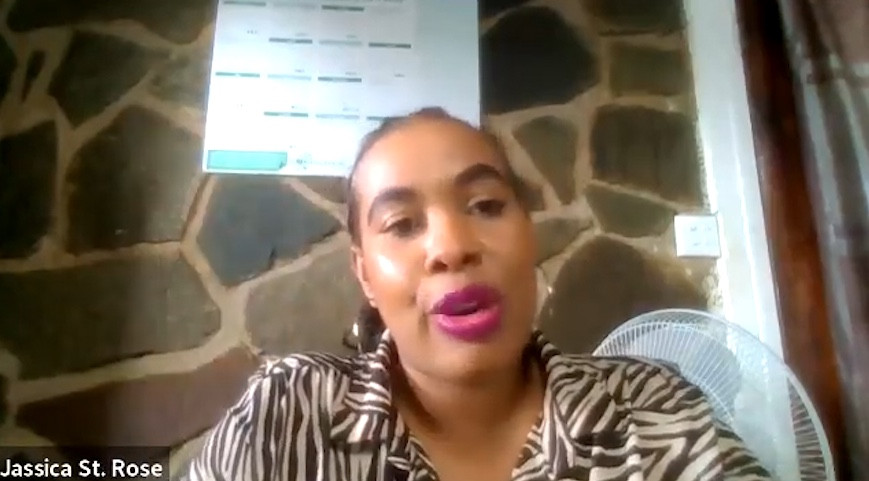
Jassica St. Rose
Outright Action International: Tackling Gender-Based Violence Against LGBTIQ People in the Caribbean
Gender-based violence against LGBTIQ people in the Caribbean is an acute problem, amplified by the continued existence of colonial-era laws criminalizing same-sex relations which, on the one hand, normalize such violence, and, on the other hand, serve to keep victims and survivors from reporting such violence or seeking other help. Tackling gender-based violence, and ensuring service provision for LGBTIQ victims and survivors of it is a key program area for OutRight in the Caribbean. In this session we will discuss the prevalence of gender-based violence against LGBTIQ people in the region, progress in tackling it so far, and strategies for increasing policy and legal protections for LGBTIQ survivors of gender-based violence in the future. Speakers: Elysse Marcellin & Jessica Rose
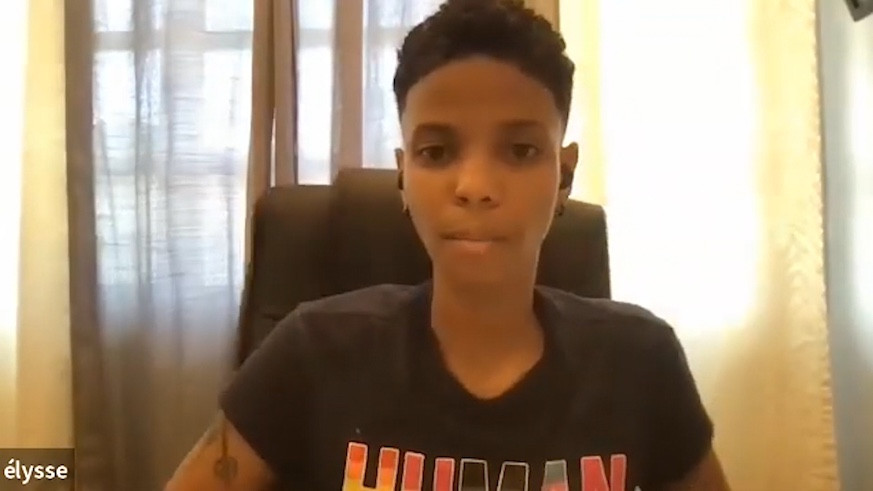
Elysse Marcellin
For rush transcript of Tackling Gender-Based Violence Against LGBTIQ People in the Caribbean, click Read More
Jassica St. Rose (00:00):
I will go over to Trinidad Elise, who can also tell us some of the key positive changes that her organization and her country in general has made in relation to protecting women and persons against gender-based violence.
Elysse Marcellin (00:17):
Yes. Thanks for that Jessica, so my address was specifically has been working with outright over the last couple of years on the frontline Alliance and gender based violence project and one of our key roles in that during phase one was to train first responders in how to work with gender based violence victims. Uboth women and LGBTI identifying people. I think that was a really instrumental part of the efforts towards ensuring that, you know, state actors and those who are responsible for working with those who are surviving or trying to escape violence, ensitized as to how to address these populations. One of the interesting things that we kind of learned through that was that I think people are hesitant to discuss this topic of LGBT identified people's rights and these things. But I think when you bring it back home to them, from the perspective of, well, you know, people are just trying to survive and they just want to be treated with respect.
Elysse Marcellin (01:20):
It makes it a lot easier to digest. And so that was part of the work we've done. And, and this year through Outright's support as well, what we'll be looking at is how the recently amended domestic violence act,whether or not it is actually in fact, working to protect LGBT identified people. Ubecause with this recent amendment they've introduced dating clause, which uses pretty broad language to define who is,identified as being in a dating relationship. Of course, you know, there's this sort of attitude like, well, we are not really going to protect LGBT people, but it, it is open now because they have not used the same language that they've used in other clauses, like visiting relationship. And cohabitant all of them use gendered language like man and woman and husband and wife, whereas a dating relationship clause is open.
Elysse Marcellin (02:16):
And so we would like to investigate whether or not people who are in same-sex or same-gender relationships have been able to access justice through that clause. So over the next year, we'll be partnering with various organizations who do work in this area to see if this clause has in fact benefited the community in any way, which we hope would be able to inform full of the efforts to sort of just amend the entire legislation to be protective of everyone. Of course last year in 2020, the gender based violence unit was launched, which was launched by the now,I suppose now past police commissioner because his term ended this year. But he had a very specific and vocal interest in ensuring that LGBT people were protected through his new unit. He is unfortunately, or fortunately, however you look at it, the only state actor to explicitly emphasize need to protect LGBT people and his intention to do so.
Elysse Marcellin (03:23):
So of course his entire tenure is a contentious one and he himself is a contentious character. But in a way where this was a progressive step forward for LGBT people to be able to recognize that at the, at the very least the highest level of the police service and seeing that this is his priority, this is something he cares about. These are two, I think like national level areas of progress that are going to be interesting to continue observing as time passes and I'll stop there for now. And we can probably talk more about some of the work and stuff later on in conversation.
Jassica St. Rose (04:01):
Okay. I'm happy that you actually mentioned the new gender-based violence act and the units that Trinad has brought so now, but we'll go into that more because I w ant to know about the impact that this can have on the community. So we'll discuss that later on. But thank you for raising that point. Elysse Marcellin if you could share with us, maybe some of the innovative ideas or measures that can be using response and prevention matter, can we can adopt or as a, as organizations or as, as a country can adopt in a Caribbean space. Andif you can explain why these measures are important, because it is important tapping made a very strong point that we need strategies to, to enhance and to bring about better protection. So if you could share with some innovative ideas as an organization and as a country in a Caribbean space and how and why these measures are important to tackle gender violence.
Elysse Marcellin (04:59):
Yes. That, that so much of that question. I mean, it's a, it's a broad question, right. And answering it, it would probably take many more hours of, you know, thoughts and analysis. But I think some key things that have emerged to me in in the work and in being in this space that are necessary is one is recognizing the impact of colonialism and where we are and that where we are right now, isn't a chance it's not by chance. It was by design. Uand that the fight we have against violence requires us to address the national epidemic of violence that exists in many of our territories. So there's violence towards children, there's violence towards women violence towards all forms of minority groups. And you're seeing, for example, now with the migration of Spanish speaking migrants, particularly from Venezuela, you're seeing now that xenophobia becoming a very common part of the narrative you're seeing now with COVID, there's this sort of rift between the vaccinated and the UN vaccinated with, you know, people thinking that there needs to be more harsh measures taken against people for, you know, not conforming in particular ways.
Elysse Marcellin (06:10):
So generally I think that what we are witnessing in our region is a culture of violence as a whole that needs to be addressed. And I think that starts with us 1: recognizing that our movements are not actually isolated, even within the LGBT space, there is antagonism from people who, for example, don't think bisexuals are legitimate, or don't think trans identities are legitimate, or don't think intersex identities should be with in this space. And all of these identities then becomenew layers upon which we divide and become antagonistic towards one another. Instead of recognizing that the system as a whole is oppressive and it is choosing these identities to oppress in specific ways, but at the end of the day, we are actually all experiencing the same overarching vulnerabilities that just manifest perhaps in more unique ways. And you know, when you, when you recognize that we've been, we've been taken so far away from our indigenous roots and our indigenous cultures that would have had space for diversity, you recognize that it means that we actually have to come now from a more holistic cultural identity, recognizing our ancestors traditions and creating new avenues to,uI think, bring those back to current consciousness.
Elysse Marcellin (07:36):
Right? So for example, I was reading about,Mali kingdom in ancient Africa in which there was actually something equivalent to a ministry of diversity or ministry of vulnerable people. And so this, this ministry essentially serve the purpose of ensuring that minority groups in this kingdom were taken care of. And I thought when I read about that, I thought, imagine this was thousands of years ago that these, our ancestors seem to have had the right answers. The fact that we have been removed from these systems was by design and was intentional. And it was designed for us to be able to have these separate, thee sort of separate ID that can be exploited, that can be oppressed. And so in terms of innovating, I think one of the things that we have to do is to actually bridge divides, Is to get to a point where we are working together and not in opposition to one another, to recognize that we are all being stripped of how humanity and that, that deprivation from humanity, that alienation from humanity is just assigning another label to it, right.
Elysse Marcellin (08:45):
But at the end of the day, we are all being deprived of humanity. I think in bridging those divides, we then become powerful. I mean, we, we've all grown up hearing there's power in numbers, you know I think we become more powerful when we recognize that we the people, actually do have the power. We just have to work together and take it as opposed to continuing to leave it vested in the hands of a minority elites whose interests are large driven by profit and by, you know, networks and these kinds of things are exploitative and exclusionary. Uand I think that when it comes to legislation, we have a tendency to sort of focus on these areas because that's what funding also focuses on. Right. We kind of go towards where the money goes and unfortunately, a lot of funders focus more explicitly on, well, less engage in legislative change.
Elysse Marcellin (09:40):
But I say they research those, that legislation is actually not the most effective way at changing the status quo. It's just one tool. And oftentimes the culture around the legislation doesn't necessarily change with it. And we can see that, for example, in the U.S. What's happening right now with active attempts to roll back progressive legislation because the societal atmosphere didn't move forward with the legislation, right? So I think that there has to be community work taking place so that once we build these bridges across movements, we have environmental activists, women's rights, activists, LGBT activists,ulabor activists. If all of us build, build bridges, and then start to develop systems that appreciate humanity and the dignity of all humans, then there is no longer need to continue focusing on, well, this specific group needs to also be given rights. Instead, we can focus on language of all of us, have an obligation to be humane to others.
Elysse Marcellin (10:37):
And I think developing programs that try and teach that and reinforce that is where we can start. And I really love that in Barbados new charter. Article 1 talks about rights being afforded and dignity being afforded to everyone irrespective of, and they include the sexual orientation, gender, and sex. But no, I think it's article article 2, that also talks about,to be part of a civil society. You have to, you have rights, but you also have a duty. And I think that is another language shift that has to take place is that we have to recognize that we all have a responsibility to sure that our neighbors are kept safe and that they are treated with respect and dignity. And I think that requires efforts towards cultural change as well.
Jassica St. Rose (11:27):
Thank you so much for this. Elise indeed shifting the entire narrative around the Caribbean and, and the whole cultural narrative, and of course in your reading or that our ancestors had the foresight, but it was taken away from us and looking at it holistically can drive change and can bring around change, but we need the constant activism to enhance that and to keep that at the top of our list. And I remember in my two day meeting, which Alexandrian was at, shifting the narrative and looking at it holistically. Uh,e of the participants at the meeting, tlked about working with immigration officers and policemen on migrant sex workers. And I, I asked the question, how is that able to come about? And the participants who worked on the project indicated that they worked with allies and, you know, not just working with allies, but talking about migrant sex workers.
Jassica St. Rose (12:32):
And if you want to also include gender-based violence, looking at the person as an individual and not just, okay, this is a sex worker, and this is a LGBT person. This is a gay person. We're not looking at it that, but we're looking at it holistically. So the, the narrative change and the cultural change important, and also bringing back the foresight of our ancestors so that we get to a point where we can look at violence as an issue that needs to be seriously taken up. So Alexandr, and if you could tell us probably some of the innovative ways, like I mentioned in Antigua, that for me, was an innovative way to have, and to work together with immigration officers and police officers, even if they are, our allies, but to tackle these specific focused areas with key populations, that for me, is an innovative, I applaud Antigua for bringing that up. So for doing such a good thing. So do you think that, n a time now where we are trying to change the narrative, that governments, we should see more activist in government position, more activists going into politics who help change this, the language around and not just the language of minority cause the language holistically. Do you, do you think that we should see that movement coming across now in the Caribbean and Trinidad, wherever regionally, tell me what you think
Elysse Marcellin (13:53):
That's a fantastic question. Honestly, I think it's a necessary part of the move towards progress. But I think the challenges is that because our political systems were designed by people who intended for us to not have access to power. It's not really as easy as you just get into it and it changes the status quo right? Because I remember learning from Sunati Mirage who was an excellent historical storyteller. If you ask me, whenever she tell talks about the history of Trinidad and Tobago. So it was fascinating, but I remember leaning from her about the fact that triada was the first crown colony where in was the first British colony, where they perfected this model of governance, where they could maintain rule over an entire, like different groups of people all the way from the UK. And they never had to set foot there other than to send a governor.
Elysse Marcellin (14:51):
I think when you understand that our political systems have been designed was ready for them to maintain power overseas. You understand why we can't just simply get into them and change the status quo. They are not designed to be changed. So I think in a real way, yes, we should be taking up space in the political arena and we should be trying to change things from the inside, but really, and truly from a long term perspective, the answer actually has to be systemic change. We have to dismantle what exists almost entirely for it to be rebuilt into something that is more representative of our needs and our politics as a community. And I think that that starts most with deciding who we are as political actors. So yes, but it's, it's a long journey.
Jassica St. Rose (15:37):
Yes, indeed. It is a long journey. And of course getting rid of that old narrative and making way for the new, I think that's where we need to go. That's what we want to see. And I think I see it a bit happening now with more younger people taking up that mantle I wanting to step step forward with that. So I believe it can happen. It may take a little more time, but in the future it will happen. Definitely.