Out-FM is a weekly progressive queer show on listener-sponsored, noncommercial WBAI/Pacifica Radio. It airs at 99.5 and wbai.org, generally on Tuesdays from 8-9 PM. Please support us by donating to WBAI. Become a member for $25 or a BAI Buddy (sustainer) for $5/month or more. Or give to our Tower Fund https://wbai.wedid.it/campaigns/10022-tower-fund/. Or go to wbai.org or call 212-209-2950 and let WBAI management know you listen to Out-FM by supporting the station with a donation. Be sure and mention us when you donate.
Sign up for Out-FM's Weekly Newsletter with show announcements.
Tune into Out-FM on Tues., March 22, 2022 from 8:00-9:00pm, on 99.5FM WBAI/NY & listen at https://www.wbai.org/listen-live/
Prof Jerry Meyer, Gay Radical
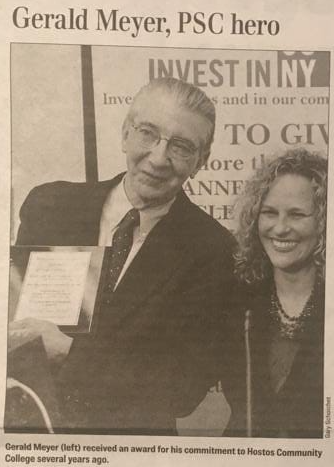
Tune in to Out-FM on WBAI.org, 99.5 FM, on Tuesday from 8-9 PM when we will remember and honor the heroic life of Jerry Meyer, a highly accomplished historian, scholar, communist activist, and, later, an out-gay man, who defined his life around solidarity with oppressed people. He died last November at the age of 80. Jerry devoted much of his life to the fight to preserve and strengthen Hostos Community College, a unit of the City University of New York or CUNY in the South Bronx, where he taught history and organized activists. Hosted by Bob Lederer as part of our Queerly Defiant series about queers who faced consequences for their fight to win peace, justice, and human rights.
On the program, Out-FM's Bob Lederer will interview two of Jerry's dear friends and colleagues, Wally Edgecombe, retired director of the Hostos Center for the Arts & Culture, and William Casari, Associate Professor and College Archivist at Hostos.
According to an article last year eulogizing Jerry in The Clarion, newspaper of the Professional Staff Congress (PSC), the union at CUNY that he helped build, "Gerald Meyer..was more than just a scholar of NYC radical activism. He lived the values he researched and taught." And longtime Puerto Rican independentista and former New Yorker Dylcia Pagan, who spent 19 years as a political prisoner, wrote, “A true supporter of our struggle for national liberation. Jerry Vive!” Dylcia’s sentiment has been shared by many Puerto Rican independence activists.
The article in The Clarion describes Jerry’s first political protest at age 15, in 1955, when his Catholic school nun teacher caught him with a book opposing Senator Joe McCarthy's Red Scare and the teacher warned the rest of her class not to speak with Jerry. He threw his books on the floor and walked out of the room, never to return. “That was very liberating,” Jerry said years later.
He went on to speak out against McCarthyism and circulated petitions for racial integration of his all-white school in Hoboken, NJ.
In the 1960s he joined Civil Rights freedom rides and organized demonstrations against the Vietnam War. In 1971 Jerry was one of hundreds who went to jail for 8 days for violating a court injunction by joining a protest supporting the 11-week strike by members of the Newark Teachers Union – even though Jerry was not a member himself.
In 1973, Jerry divorced his wife and came out as a gay man. He also joined the Communist Party USA, which he had been close to for a long time, but left within several months for reasons unknown to his friends. However, it is interesting to note that the Party – from the 1930s until the 1990s - had a firm policy forbidding membership by openly gay and lesbian people and an official view that homosexuality was both a security risk as far as state repression and a form of bourgeois decadence. Interestingly, 11 years before Jerry came out, in 1962, as an undergraduate at Rutgers, the liberal club in which he was active invited as a speaker a member of the Mattachine Society, the primary reform and support organization for gay men and lesbians in the pre-Stonewall era. This was a daring act to do during that homophobic period.
Turning to Jerry Meyer’s academic career, in 1972 he was hired as an assistant professor of Behaviorial and Social Sciences at Hostos Community College and quickly became a leading voice for students and faculty. The school’s first home -- for many years until the successful struggles led by Jerry -- was a shabby refurbished tire factory. Later that year, Jerry became founding chair of the school chapter of the Professional Staff Congress, the union representing faculty and staff.
According to Joshua Freeman, a retired distinguished professor of history at Queens College, "When in 1975 and 77, during NYC's fiscal crisis, CUNY administrators repeatedly tried to shut down Hostos, Gerald Meyer took the lead in the fight to save it. As head of the faculty's Save Hostos Committee, Jerry built alliances with students and community groups and helped orchestrate a flood of letters, petitions, demonstrations and lobbying that, along with a campus occupation, ultimately forced CUNY to reverse its decision, a rare victory in a very difficult time." Today Hostos has 6 well-equipped buildings.
At Hostos, Jerry helped establish the Gay and Lesbian Club, an emergency scholarship program, and the Hostos Solidarity Coalition, about which you'll hear him speak in a minute.
He also researched and wrote the biography, Vito Marcantonio: Radical Politician, 1902-1954. Marcantonio, who was Italian American, was elected to the U.S. House to represent East Harlem/El Barrio, at that time a mainly Puerto Rican and Italian-American area on the ticket of the leftist American Labor Party, and became a prominent supporter in Congress of independence for the U.S. colony of Puerto Rico. Jerry then helped launch the Vito Marcantonio Forum, dedicated to advancing the life and work of that activist politician.
Later, along with Philip Cannistraro, Jerry co-edited The Lost World of Italian American Radicalism, which includes a section of Italian-American lesbian and gay fiction. I would note that Jerry himself was of Irish descent. Jerry published sixty articles and reviews on many subjects, including the intersection of radicalism and immigrants, culture and the Left.
He retired from Hostos in 2002 as a full professor but returned two years later as a part-time adjunct faculty member and made a generous donation to the school scholarship fund. In this period he also became active as a board member of the Brecht Forum, a home for many years of radical left educational programs in Manhattan's West Village.
His many colleagues and admirers in the Bronx and nationwide have been deeply grieving his loss.