Who is the Terrorist?
A Commentary on Wicked by Peter Jonas
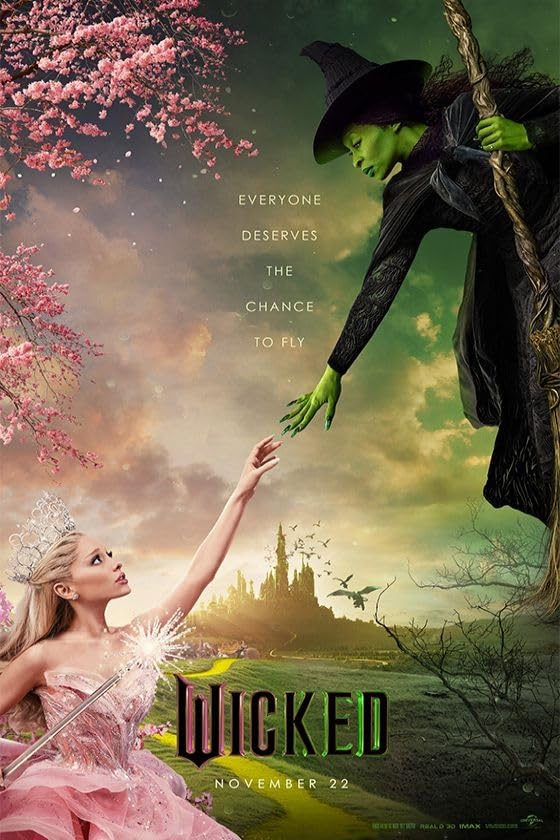
“The witch of the west is dead!” belts the jubilating ensemble, and “no one mourns the wicked.” But who and what is wicked? Such is the question that comes up in Wicked Part I, a new musical film based on gay author Gregory McGuire’s dark novel of the same name, sans the part I, subtitled The Life and Times of the Wicked Witch of the West.
In McGuire’s much too timely tale, Elphaba, formally known to us in the Wizard of Oz as the Wicked Witch, feared and ostracized due to her green skin which she was mysteriously born with, is a renegade in a fascist state, a diehard activist in the underground resistance; and yes, the fascist state is Oz, and the ruthless, authoritarian ruler is the great and powerful wizard.
Thus we have a prequal that tells a different story, where we get to know an enchanted heroine who we once thought as villain. In turn, we face a questioning that we should continuously apply to modern day socio-politics: Who is the monster and who is the warrior; who is the terrorist and who is the freedom fighter; …and is there really a fine line between good and evil with a simple choice between one or the other?
As one who obsesses on reading books and seeing them come to life on stage or screen, I never expect the adaption to be the book. But I do hope for common themes to be followed. I saw Wicked on Broadway in the early aughts with its fabulous original cast inclusive of Edina Menzel, Kristin Chenowith, Joel Gray, and a whole slew of very sexy jumping monkeys. My viewing came shortly after reading the book and I was both awed and insulted. Both my awe and my insult have just been reincarnated 20 plus years later having seen the new film following a reread.
While I was blown away by the stunning visuals, from the sets of Munchkin Land and Emerald City to the gorgeous, draggie costumes and stellar choreography…as the queer in me appreciates magic, witchiness, flamboyance, gay presence, homoeroticism, high camp, a queer lead as Elphaba is played by Cynthia Erivo, the still foxy yet also still unfortunately straight Jeff Goldbloom as the wizard, WOOF!, and as one who, like most queers, identifies with being an outcast and appreciates the empowerment of one… I was nonetheless once again insulted by the dumbing down that originally occurred presumably to make a Broadway buck.
Book Elphaba enrolled in college on her own rather than, in the film, as an attendant for her disabled sister Nessarose, previously known as the Wicked Witch of the East, who, in the book, didn’t start school at Shiz University until Elphaba was a few years in. More importantly, on screen and stage, Glinda the good witch, formulated with accuracy but profoundly stretched into a stereotypical, vapid, materialistic, conceited, white, beauty queen of a college roommate, sings to Elphaba, “I’m gonna make you popular,” patronizingly offering her how to dress, wear her hair, and act around boys. Yet book Elphaba didn’t find her roommate’s phony shallow shenanigans appealing and she managed to find her way without this ridiculous display of white saviorism, as Elphaba, stigmatized for her green skin, was played by a Black woman. If fact, it’s Glinda who rejects her high society friends and gravitates toward and is intellectually stimulated by Elphaba. While the film does begin to cover this, the indication that Elphaba wants or needs approval based on Glinda’s vacuous standards of classic high school cliquyness is quite the demeaning stretch.
McGuire’s original Elphaba is smarter. She’s a studious, engaging, philosopher who challenges peers and elders, who dares to question Oz’s monotheistic Unionism and its mythology that rationalizes an apartheid state. This questioning and rejection ties in directly with her passion for social justice and subsequent activism which takes over her life. Again, I hardly expect everything to be the same. But what was selected for erasure and alteration seems to have had a racist, misogynist influence.
In any case, both in the book and live action adaptions, the story explores a complicated life of a righteous, magical misfit who, as an advocate for anthropomorphized animals, a class of citizenry whose lives are in ruin after being completely stripped of their rights, is villainized and scapegoated for political purposes. Elphaba is a witch. Witches in particular, and powerful women in general, have a long history of being seen as a threat, at being criminalized, portrayed as evil, sociopathic, and dangerous, and violently persecuted for being who they are and exercising their power. And so Elphaba is dubbed wicked. A terrorist.
As we approach the oncoming fascism of the tRump regime, it is all the more important to be wary of weaponized terminology among the plethora of propaganda and misinformation in the media that serves to justify not only ruthless foreign policy, but also the curtailing of constitutional rights of speech, assembly, and due process. A federal bill threatens to, with no due process, shut down non-profit organizations deemed terrorist. Another pushes to withhold financial aid, to revoke visas, and deport students who participate in protests that are surmised by government officials to be pro-terrorist…in other words Palestinian advocacy.
Multiple draconian state bills are attempting to redefine domestic terrorism as participation in street demonstrations and civil disobedience, to be charged as felonies punishable with a sentence of 5 years to life. A Georgia bill’s definition of terrorism includes ideological advancement and engagement in boycotts. A bill in West Virginia, which threatens the right to assemble, provides immunity for anyone who violently attacks a protest. Thus, the terrorist label, and subsequent loss of basic civil rights, is dependent not on peaceful disruption falsly equated with violence, but on which direction the made up or actual violence is flowing.
Worthiness of the questioning of terrorist designation is not limited to peaceful forms of activism misconstrued as violent, but actual acts of violence as well. The charge of terrorism, which was not given to any of the January 6th capital rioters, has been given to Luigi Mangione for gunning down the CEO of United Health. Yet some view his action as armed resistance against a leader with a sea of blood on his hands due to callous policies of claim denials, often by artificial intelligence, that lead to avoidable, mass suffering and death for nothing other than excessive profit and concentrated wealth. While such justification may be debatable, such debate is often shut down once the label of terrorist is applied.
Nixed from stage and screen (at least so far in part I), book Elphaba participates in a plot to assassinate a murderer and fascist collaborator. How many times have we heard, “if only someone killed Hitler early on…” If they did, would they be seen as a hero or a terrorist? Depends on who’s reporting.
This is not to advocate for violence. It’s about putting into perspective how violent acts are viewed and addressed, whether they are immediately condemned or justified—and glorified--depending on who’s side one is on. When we hear war reporting with claims of so called surgical striking that is not seen as terrorism due to bombs supposedly not targeting “innocent civilians,” who is seen as non-innocent? If a young soldier had faced the choice of either conscription or prison and torture, or if they are in a position where they are defending their land and people who are under attack, are they really deserving to be targets? Are they, or anyone else associated with the opposing side of a conflict, unworthy of due process when captured? Are their leaders unworthy of negotiation, all due to the label of terrorist that was thrown on them based on political and often racial bias that fails to consider the terror that was systemically waged against the accused and their communities?
In all, I question violence. Even more, I question the glorification of the warrior and of war. Yet within the reality of political violence, when we hear the story of Elphaba and fascist Oz in McGurire’s Wicked, whether or not movie Elphaba was an assassin, we need to drop our mythological good-evil dichotomy and recognize nuance. We need to learn to research back stories and consider complicated scenarios rather than accept at face value harmful, baseless good guy bad guy narratives that come at us in simplified sound bites from embedded sources.
Yes, Wicked is a work of fiction, yet if, after knowing her as nothing other than L Frank Baum’s Wicked Witch, if we can, in McGuire’s retelling, recognize the righteous power of Elphaba as she challenges authoritarianism and apartheid in a campy film, we can also challenge ourselves to look past one sided, politicized, destructive terminology and simplified narratives that rationalize draconian domination and violent repression.
Here's to you, Elphaba, as you defy both gravity and tyranny
Take your broom and fly, Witch!
Your story is told.
And wicked you are not.